
TURN THE MOISTURE IN THE AIR INTO A NEW POSSIBILITY FOR WATER GENERATION
Take a moment to think about something that is constantly around you but usually goes unnoticed.
Water vapor in the air.
Under the right conditions, atmospheric moisture can be condensed into liquid water.
That simple physical principle is the foundation behind atmospheric water generation — and it opens the door to an interesting DIY approach for people who want to learn how such a system can be assembled and understood.
That is the concept behind Joseph’s Well.
It is not simply about water. It is about preparation, knowledge, technology, and having more options.
WHAT IF AN ADDITIONAL WATER SOURCE COULD COME FROM THE AIR AROUND YOU?
Most people think about water through traditional sources:
- municipal water;
- wells;
- reservoirs;
- rivers;
- springs;
- bottled water;
- rainwater collection.
But there is another technological possibility:
capturing moisture naturally present in the atmosphere.
The basic principle is straightforward.
Air contains water vapor. When temperature, humidity, and cooling conditions are suitable, that vapor can condense into liquid water.
The challenge is designing a system that can collect, filter, treat, and store that water appropriately.
That is where this DIY concept becomes particularly interesting.
FROM AIR TO WATER: HOW THE CONCEPT WORKS
The process can be understood through several fundamental stages.
STEP 1 — AIR INTAKE
Ambient air enters the system carrying a certain amount of moisture.
STEP 2 — CONDENSATION
The air encounters a sufficiently cool surface or environment, allowing part of its water vapor to condense into droplets.
It is similar to what happens when moisture forms on the outside of a cold glass in a humid environment.
STEP 3 — COLLECTION
The condensed water is directed into an appropriate collection area.
STEP 4 — FILTRATION AND TREATMENT
This is one of the most important stages.
Condensed atmospheric water should not automatically be assumed to be safe for drinking.
Proper filtration, treatment, hygiene, and storage practices are essential when water is intended for human consumption.
STEP 5 — STORAGE
Proper storage helps minimize the risk of contamination after treatment.
DISCOVER THE JOSEPH’S WELL APPROACH
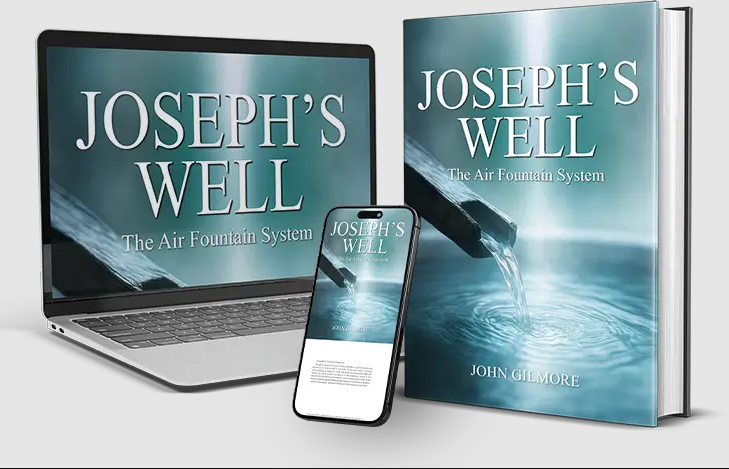
Joseph’s Well is presented as a DIY digital guide for people interested in learning about atmospheric water generation and understanding how to assemble a system using accessible components and practical principles.
The material is designed to organize the concept into understandable steps and help users explore areas such as:
- components;
- system structure;
- condensation principles;
- energy requirements;
- filtration;
- storage;
- maintenance;
- troubleshooting;
- possible configurations.
Rather than simply purchasing a finished commercial machine, the approach focuses on learning and building.
WHAT CAN YOU LEARN?
The material can provide guidance related to:
STEP-BY-STEP PROJECT
A structured approach to understanding how the system can be assembled.
COMPONENTS
Information about the elements required for the proposed setup.
DIAGRAMS AND SCHEMATICS
Visual resources designed to make the relationship between components easier to understand.
POWER REQUIREMENTS
Information related to powering the system and considering different energy configurations.
FILTRATION
An explanation of why proper water treatment is essential.
MAINTENANCE
Important considerations for keeping the system clean and functioning properly.
OFF-GRID APPLICATIONS
The concept may also appeal to people exploring alternative solutions for rural properties, remote locations, or off-grid projects.
WHY CONSIDER THIS APPROACH?
1. A POTENTIAL SUPPLEMENTARY WATER SOURCE
Atmospheric water generation can potentially serve as an additional source of water, depending on environmental conditions and system configuration.
2. GREATER PREPAREDNESS
Understanding multiple ways of obtaining and managing water can be valuable when preparing for unexpected situations.
3. A DIY PROJECT
For people who enjoy building, learning, adapting, and understanding technology, this approach provides an engaging hands-on project.
4. INTERESTING TECHNOLOGY
It offers a practical way to explore the physics of condensation and atmospheric moisture.
5. OFF-GRID POTENTIAL
With an appropriate configuration and sufficient energy, the concept may be considered for certain off-grid environments.
6. KNOWLEDGE AND SKILLS
Learning how atmospheric water generation works can help you better understand alternative water technologies.
HOW MUCH WATER CAN IT PRODUCE?
This is an important question.
There is no single production figure that applies to every environment.
Performance can vary depending on:
- relative humidity;
- temperature;
- airflow;
- condensation capacity;
- component efficiency;
- system configuration;
- available energy;
- maintenance;
- environmental conditions.
Warmer, more humid environments generally provide more favorable conditions for atmospheric water condensation than very dry environments.
For that reason, claims of a fixed production rate regardless of location should be approached carefully.
IS THE WATER SAFE TO DRINK?
This distinction is extremely important.
Condensing water from air does not automatically make it drinking water.
For human consumption, factors such as the following must be considered:
- air quality;
- materials used in the system;
- filtration;
- treatment;
- cleanliness;
- storage;
- possible contaminants;
- microbiological quality;
- applicable local regulations.
Always follow the product’s technical guidance and applicable safety requirements.
WHO MAY BENEFIT FROM THIS PROJECT?
The concept may be particularly interesting for:
✓ People interested in emergency preparedness
✓ Families exploring alternative water solutions
✓ Rural property owners
✓ Off-grid enthusiasts
✓ Campers and outdoor enthusiasts
✓ DIY project enthusiasts
✓ Sustainability-minded individuals
✓ Technology enthusiasts
✓ People living in areas where alternative water strategies may be useful
WHO MAY NOT NEED IT?
This may not be the right option for someone who:
- wants a ready-to-use commercial machine;
- does not want to assemble components;
- has no interest in DIY projects;
- expects identical production in every climate;
- wants a system that completely replaces all other water sources;
- does not want to perform maintenance and hygiene procedures.
The concept is designed for people who want to learn, build, and explore another possibility.
PREPAREDNESS DOESN’T HAVE TO MEAN FEAR
Preparation can simply mean having options.
Imagine a temporary interruption in your normal water supply.
Some people may depend entirely on stored water or rush to find another source.
Someone who has prepared beforehand may have several strategies available:
Water storage.
Rainwater collection.
A well.
Traditional sources.
And, depending on environmental conditions and system configuration, atmospheric water generation.
The more options you understand, the more prepared you can be to make informed decisions.
FREQUENTLY ASKED QUESTIONS
Is Joseph’s Well a ready-made machine?
No. It is presented as a DIY guide/project designed to help users understand and assemble an atmospheric water generation concept.
Do I need to be an engineer?
Not necessarily. However, users should carefully follow technical, electrical, and safety instructions.
Does it work in every climate?
The principle can be applied under different conditions, but performance varies significantly with temperature and humidity.
Can I use solar power?
Depending on the configuration, solar power may be considered. Proper sizing of solar generation, batteries, and system consumption is essential.
Is the water automatically drinkable?
No. Condensed water should not automatically be considered safe for drinking. Appropriate filtration, treatment, and storage are necessary.
Does the system require maintenance?
Yes. Components involving air, water, electricity, and filtration require appropriate cleaning and maintenance.
Can it be used on rural property?
Depending on environmental conditions, available energy, and system configuration, it may be an interesting option for certain rural applications.
Is it better than a well?
There is no universal answer. They are different technologies with different requirements, costs, advantages, and limitations.
Is it better than storing water?
Not necessarily. Water storage remains an important preparedness strategy. Atmospheric generation can potentially complement other methods.
How much does it cost to build?
The total cost depends on the components, tools, configuration, and local availability.
How much water will I get?
Production depends on environmental conditions, humidity, temperature, energy availability, and system configuration.
Can it work in dry conditions?
It may still produce some water under certain circumstances, but lower humidity generally makes atmospheric condensation more challenging.
Is it an emergency water solution?
It may form part of a broader preparedness strategy, but it should not be treated as the only emergency water source.
Is it worth learning about?
If you are interested in preparedness, technology, sustainability, DIY projects, or alternative water systems, it is certainly a concept worth exploring.
DISCOVER A DIFFERENT WAY TO THINK ABOUT WATER
Water surrounds us.
A portion of it exists invisibly in the atmosphere as water vapor.
Atmospheric water generation takes that natural phenomenon and turns it into a technological possibility.
If you are interested in technology, DIY projects, preparedness, sustainability, and alternative approaches to water independence, take a closer look at Joseph’s Well and discover how the project works.
👉 CLICK HERE TO EXPLORE THE PROJECT
Learn. Build. Prepare. Explore new possibilities.
IMPORTANT DISCLAIMER
This page is provided for informational and promotional purposes only. Joseph’s Well is presented as an educational/DIY project. Water production depends on environmental conditions, components, system configuration, and available energy.
Water intended for human consumption must be appropriately treated and safely stored. Testing may be necessary to verify water quality. Always follow the product’s instructions and applicable local health and safety regulations.
AFFILIATE DISCLOSURE
This page contains affiliate links. If you choose to purchase the product through one of our links, we may receive a commission at no additional cost to you.
Our goal is to provide clear and useful information so you can independently decide whether the product is appropriate for your needs.
Preparedness begins with knowledge.